


Templates
Search results
Use with caution: CandidateAbout
Users need a way to filter and sort information like search results, long lists (such as facilities, providers), and data sets so that they can find relevant information quickly and easily. Users encounter filter and sort actions in many different contexts, with different types of information.
Information such as:
- Search results
- Site search
- Resources and support
- Refining lists of information
- Medications
- Appointments
- Secure messages
- Claims
- History
- Data sets
Contexts such as:
- within a form
- on a search results page
- within a form AND viewing search results
- within a knowledge base such as Resources and support
- sorting data in a table
Examples
Results only
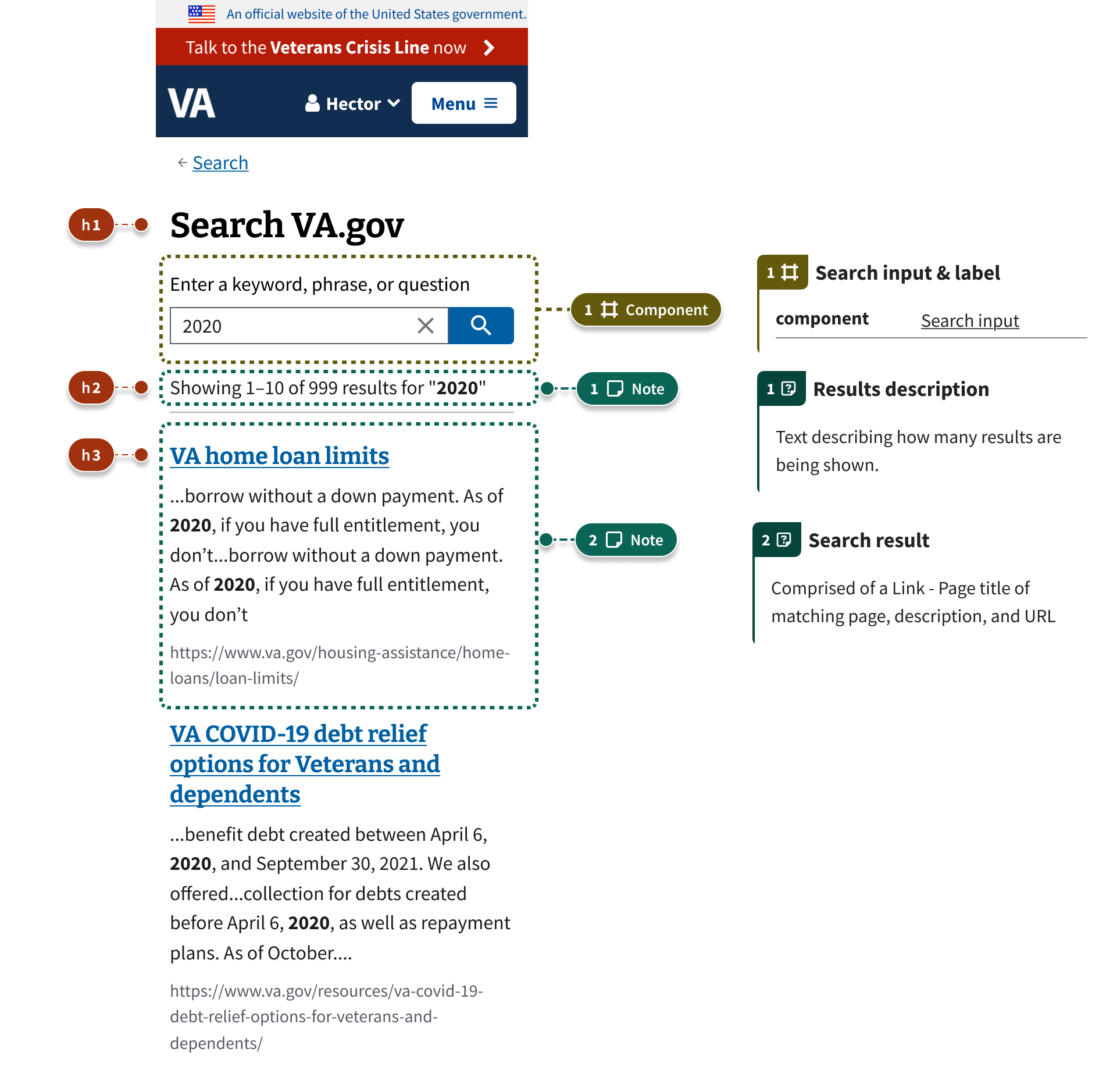
Filter and sort
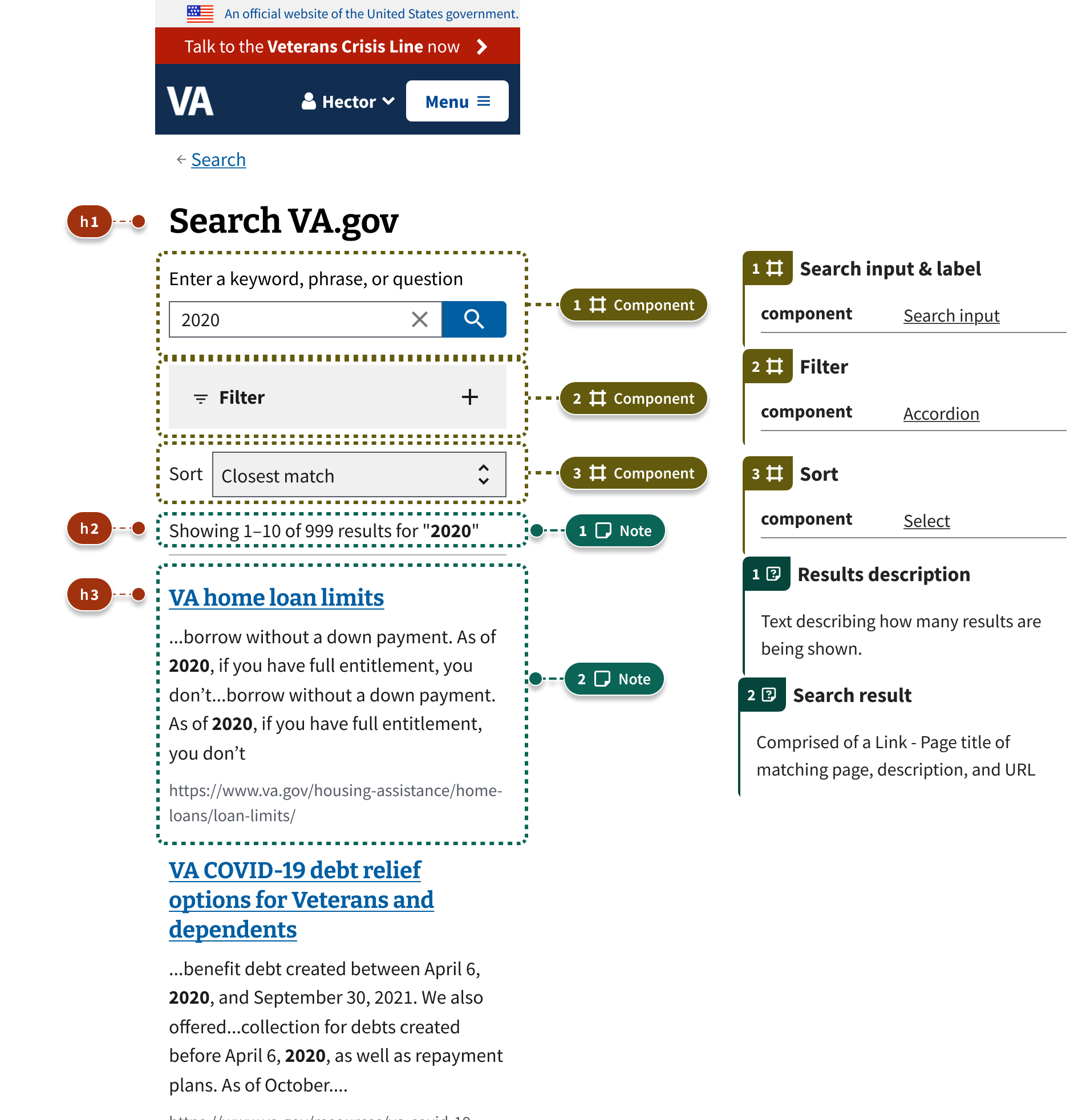
Filter and sort with active filter chips
Filters
See the Search Filter component.
Search result
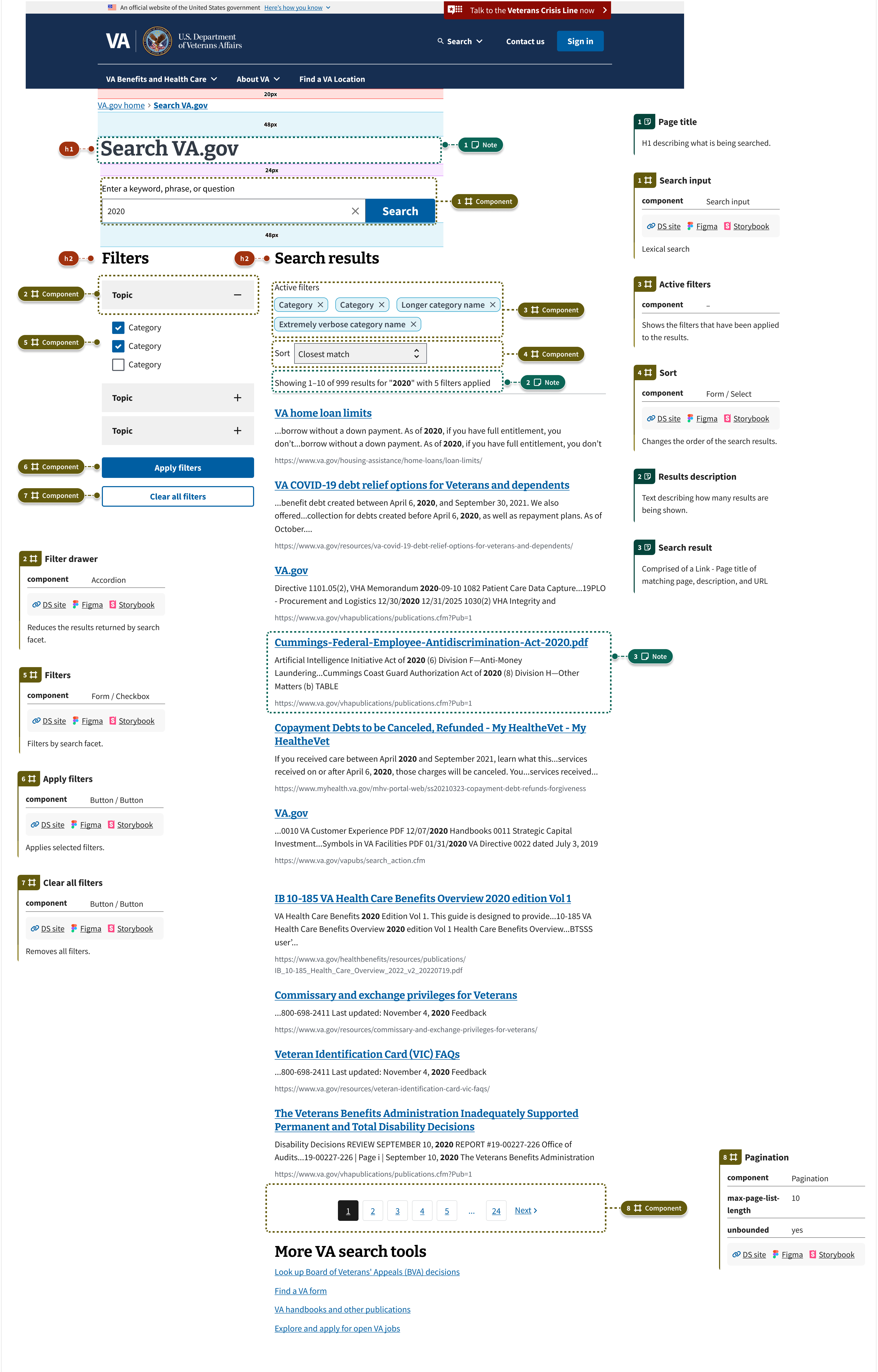
Structure - Search results page
Search results page
The search results page can feature all of the following, but not all aspects are required.
- Page title
- Search Input
- Active filters
- Filters
- Sort
- Results description
- Apply filters
- Clear all filters
- Pagination
- Search result
Page title
H1 describing what is being searched.
Search Input component
Allows the user to enter a search query. Use the Search Input component.
Active filters
Active filter chips that show the currently applied filter values.
Filters
Search Filter component which includes checkbox and radio button components that allow the user to filter search results by facets.
Sort
Sort component which utilizes Select as its foundation. It allows the user to change the order of the results.
Results description
Text describing how many results are being shown.
Structure
The implementation should follow this format:
- Showing 1–10 of 999 results for “[query]”
- When used in non-search contexts, omit the
for "[query]"portion. - If a filter is applied to the results, add “with X filters applied” to the end. This is not necessary when sorting is applied since the Sort component itself acts as the visual indicator.
- When used in non-search contexts, omit the
Additional guidance
- The results description should not be a heading, since it does not label or introduce a new section of content. A stable, targetable element (for example, an ID) is sufficient for focus management.
- Avoid inline elements (such as
<strong>or<span>) within the results description when possible. Plain text produces more consistent announcements across assistive technologies and reduces the risk of fragmented announcements, especially in VoiceOver.
Announcement approaches
Teams should use one of the following approaches to announce updated results.
Live region approach
Use role="status" on the results description to announce updates when the content changes.
role="status"provides an implicitaria-live="polite", so adding an explicitaria-liveattribute isn’t necessary.
Focus management approach
Move focus to the updated results description after results change.
- Add
tabindex="-1"so the results description can receive programmatic focus. - The results description should be announced as a single cohesive sentence.
Additional considerations
- If inline elements are required and you are using a live region approach other than
role="status",aria-atomic="true"may help, but announcement behavior can still vary across screen readers. - Don’t combine live region and focus management approaches on the same results update, as this can create duplicate or repetitive announcements.
Apply filters
Button - Primary component that applies filters that have been selected.
Clear all filters
Button - Secondary component that removes all filters.
Pagination
Pagination component allows users to move between pages of search results.
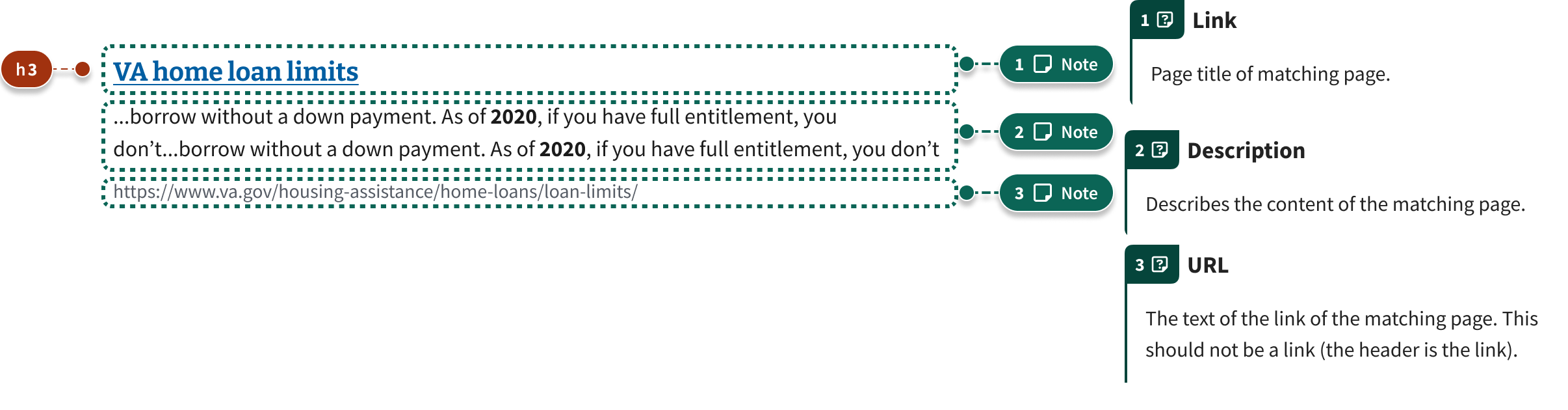
Structure - Single search result
Single search result
Link - Page title of matching page
This should match the H1 of the page that the result will link to.
- Implemented using a header, typically a H3 or H4.
- Should also increase the distance between the text and link underline as well as reduce the thickness of the underline (text-underline-offset: 3px; text-decoration-thickness should resolve to 1px)
Description
Describes the content of the matching page. Typically using content from the meta element named description in the page itself.
- Must bold the text in the description that matches the search query.
URL
The text of the link of the matching page. This should not be a link (the header is the link).
How to design and build
Filtering
Sorting
Accessibility considerations
Follow these accessibility guidelines when filtering or sorting your search results:
- For filtering, move focus to the results description or the results heading. This orients users and helps them find updated content quickly.
- For sorting, maintain focus on the component. Users may not expect implicit submission, so moving focus to the results description or results heading could be disorienting.
- Announce updates after filtering or sorting. Use an ARIA live region to announce when results have updated, including the number of results found. This helps screen reader users know their action was successful.
- Preserve the filtered and sorted state. Make sure selected filters remain visible and accessible after results update, so users always know which filters and sort order are active.
- Announce loading states. If results take time to update, use an ARIA live region to let users know results are loading.
- Provide clear error messages. If there’s an error applying filters or sorting, show a clear message and announce it for screen reader users. Use simple, direct language.
Additional guidance
- Use filter chips to show the filters being applied when there are more than 3 facets. 3 or more facets requires the use of filter chips to show what is currently selected in filters.
- Use a left-hand sidebar when the main purpose of the product is to search. If your product’s main purpose is to allow users to search, then use a persistent, visible, left side navigation from the tablet breakpoint and wider viewports. For example, global Search, GI Bill Comparison tool, and Resource & Support (or other knowledge bases) feature search, filtering, and sorting as the main focus of their products thus they would use a persistent side navigation to hold filtering.
- Sort and filtering are not the same! Do not conflate the Sort action with the Filter action. Sorting is for reordering results whereas Filtering is for narrowing them down.
- Filtering happens inline on the page. Do not take users to a new page or screen in order to filter search results.